
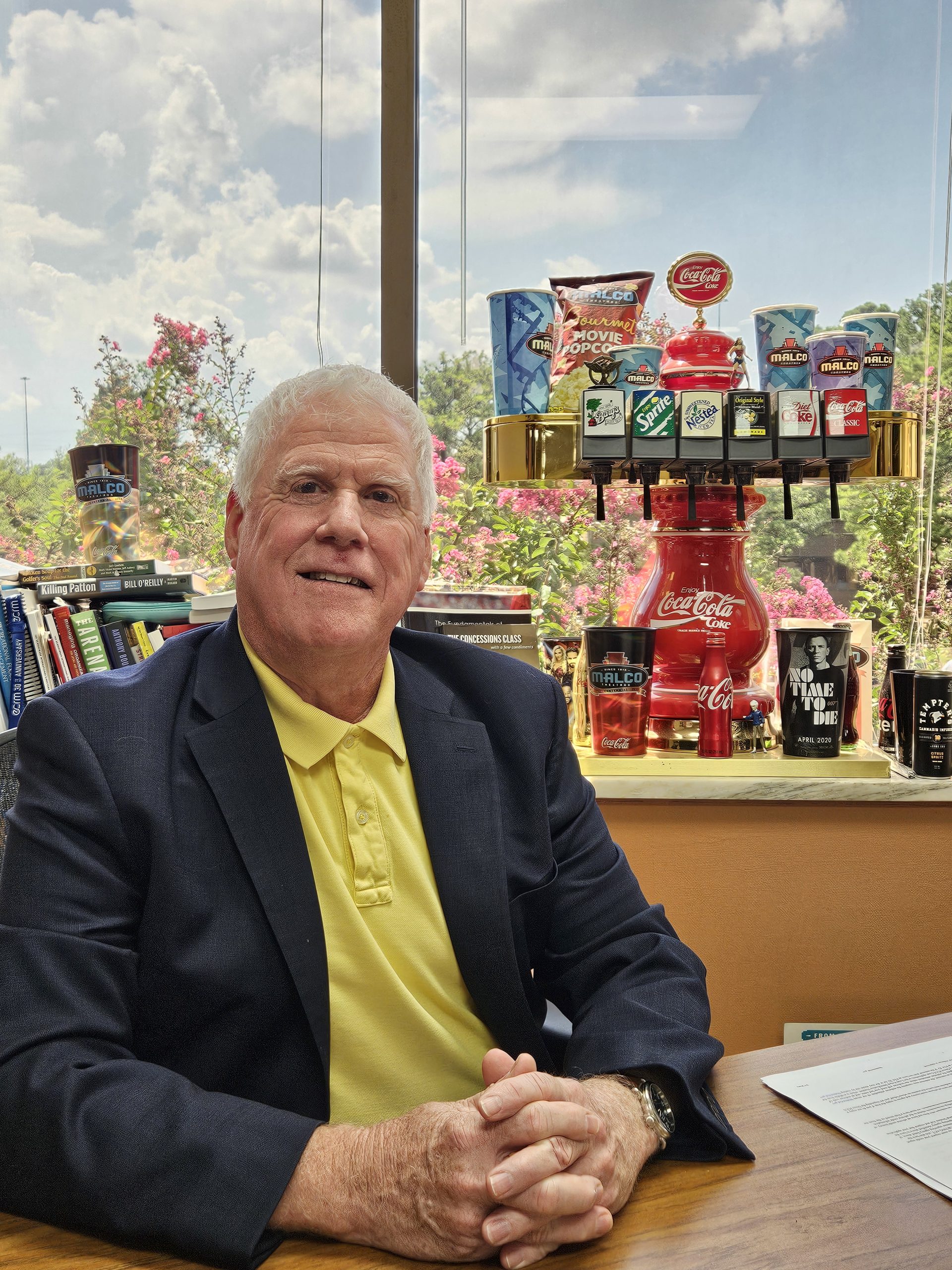
Throughout his career, Larry Etter has worked tirelessly to modernize and professionalize the concessions industry. The veteran concessionaire, whose work in the industry spans five decades, has left an indelible mark on the food and beverage business in cinemas. As the recipient of this year’s Frank Liberto Award at Cinéshow, Etter will be receiving an honor named after one of his mentors. The award is given annually to an executive who embodies excellence among concessions and purchasing professionals in exhibition. Boxoffice Pro spoke with Etter, current senior vice president of Malco Theatres, a circuit he’s been a part of since 1997, to review the biggest changes in the business since he joined the industry in the 1980s.
You’re receiving an award named after Frank Liberto, a titan of the concessions space in this industry. I understand you knew him personally.
Frank was a mentor to me, and that’s why receiving this award means so much to me. I met Frank at ShoWest in 1985 and realized from the very start that he was a mover and shaker. He knew everyone in the industry; if you wanted to be connected and network, Frank was the person to get to know. He was at my first board meeting for the National Association of Concessionaires in 1993, and I recall thinking that we shared many of the same principles and common beliefs back then. It was our responsibility, as leaders, to professionalize what I like to call the recreational food service industry. You see, before the ‘90s, our industry was seen as overpriced and undervalued. There was an image of concessionaires as traveling salesmen who would go from city to city and overcharge for watered-down sodas, tricking people into paying too much for popcorn. We both believed the legitimate people in this line of work weren’t getting enough credit for their business acumen.
What were some of those changes that took place in the ‘90s that helped professionalize and raise the standards to ensure that best practices were established across the industry?
A lot of it had to do with better equipment. At the time, nacho cheese was sold in 10-pound cans, and it would be placed in a fudge warmer at the back of the concessions stand. You had to use a ladle that dipped into the cheese, and it would always leave a mess. Frank was instrumental in creating the nacho dispenser that you see today, which comes in bags with a peristaltic pump that pulls the cheese out. It’s more sanitary, it’s cleaner, and it’s safer. Frank was a very creative entrepreneur. He wanted to make it easier for everyone to sell whatever concessions items they had. He was way ahead of his time and way ahead of the curve.
The most significant changes we’ve seen in the industry have been driven by software. I remember working in stadium concessions stands where all you had to take orders was a cigar box and a price list where everything cost a quarter, dime, or nickel—so you wouldn’t have to make any change. Who knows how much money went missing back then?
In 2003, Malco was one of the first cinema circuits to introduce kiosks for food ordering. We modeled it after Disney theme parks, and our goal was to encourage people to order food in advance. It didn’t work out well because at the time, the cost and implementation of the kiosks were more than the return. We saw a 10- to 12-percent increase in sales, but the financial model didn’t work until the cost of the technology decreased. Now look at where we are today with in-seat ordering. We’re delivering food to people’s seats.
While technology has made it easier to manage some aspects of the concessions business, it’s also a sector that has evolved significantly with the introduction of alcohol service and expanded menu offerings. Is it more difficult to run a cinema’s food and beverage business today than it was when you started?
Every time you take two steps forward, you probably have to take a step back. From 2005 to 2010, we overemphasized big food in our theaters. We saw stadiums and arenas expand their menus during that period, but they did so by having different stands in various locations where fans could purchase items. One stand sells hamburgers, the next will sell pizzas, and the next can do sandwiches. Movie theaters don’t have the space to replicate that model, so we need to be careful to prevent the menu from becoming overwhelming. The typical movie theater menu should consist of around 12 to 15 items. I think hand-to-mouth items like pizza, chicken tenders, and burgers work best with our setting.
You can’t offer everything, and if you do, everything gets diluted. There is not enough kitchen space in the way movie theaters are configured, and food delivery can easily become convoluted, weighing down the entire experience.
The same thing can happen with alcohol service. A bartender’s recipe book could be 300 pages long, but it’s always better to stick to the basics. Vodka, tequila, three different types of beers, a red wine, a white wine, a sparkling wine, and a rosé. The simpler you keep it, the easier it is to manage.
Alcohol service has exploded nationwide. Did you anticipate this type of expansion for wine, beer, and liquor at movie theaters?
At the start of my career, no, but as we progressed into the 2000s, I remember Malco’s Studio in the Square location was the first in the state of Tennessee to serve beer and wine. It was a real pain in the neck to get a license, because it had never happened before. The greatest fear from outsiders was serving underage guests, so it was always frowned upon because movie theaters were seen as places for teenagers and kids under the age of 21. We completely ignored our audiences in their 30s, 40s, and above. It was a miscalculation; if you go to a baseball game, you can buy a beer in every corner of the stadium. We have since grown out of that phase and embraced serving our older audiences.



Share this post