
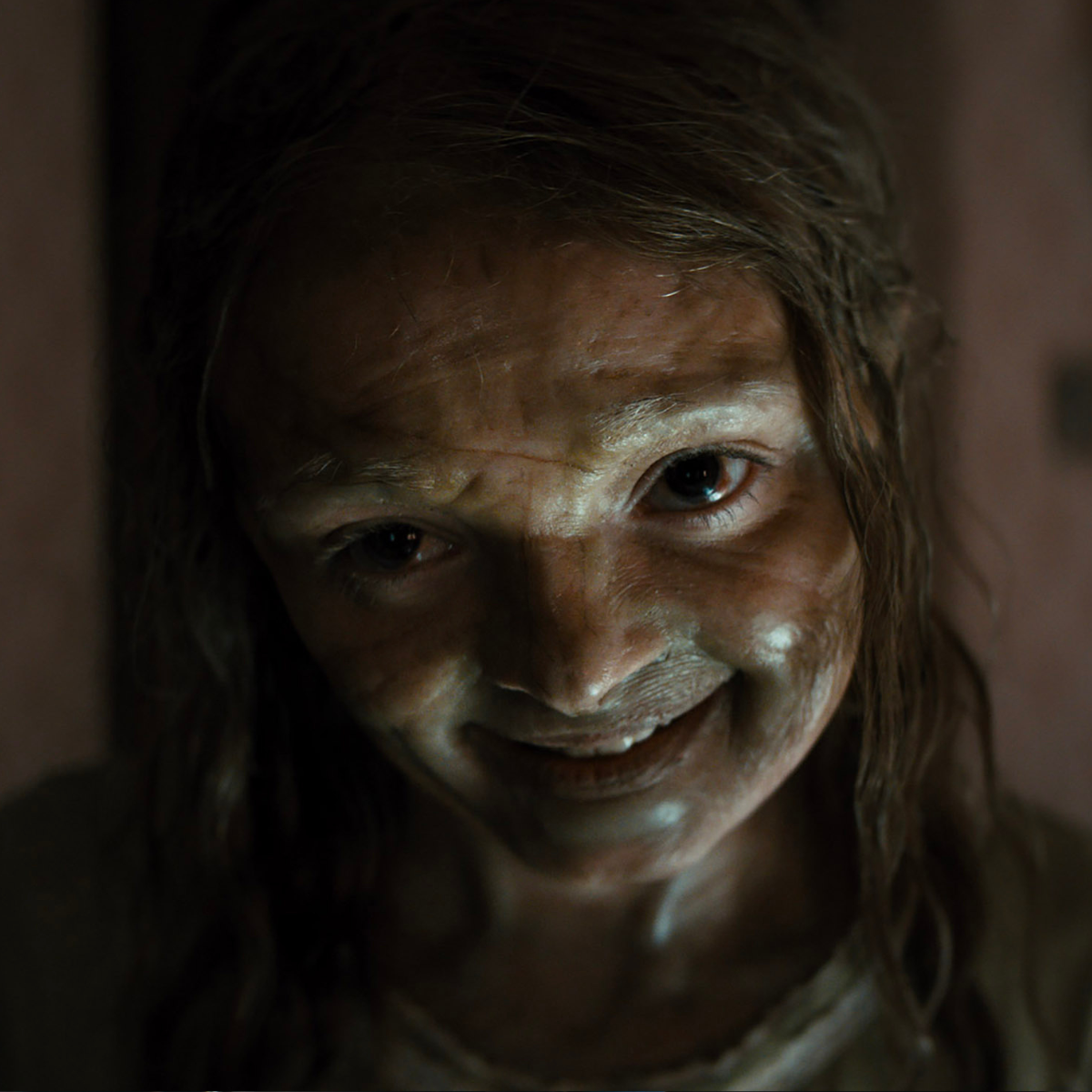
This spring, Warner Bros. brings audiences new twists on undead horror icons with Maggie Gyllenhaal’s The Bride! and Lee Cronin’s The Mummy. Unlike the literary roots of other classic monsters, a real-world fascination with ancient Egypt and its customs—along with the excavation of Tutankhamun’s infamous “cursed” tomb—gave rise to the first cinematic mummy, turning headlines into horror. Born from a fear of the Pharaoh’s curse, the movie mummy has always embodied our anxieties about disturbing the dead. Reimagining that myth through a contemporary lens, Irish filmmaker Lee Cronin grounds supernatural terror in domestic turmoil, following the family of journalist Charlie Cannon (Jack Reynor), whose daughter Katie (Natalie Grace) vanished without a trace, only to miraculously be unearthed from a 3,000-year-old sarcophagus eight years later.
As in Evil Dead Rise and The Hole in the Ground, Cronin conjures fear from the family dynamic, turning traditionally safe spaces into threatening places. Warner Bros.’ teaser campaign features a hieroglyphic-inspired Morse code message from Cronin that cautioned, “Some that passed over were gone forever, but an unlucky few were consumed by a darkness far more evil than anyone could have ever imagined. Today it begins.” As Lee Cronin’s The Mummy begins unwrapping in theaters on April 17, Boxoffice Pro spoke with writer/director Cronin about excavating the legacy of mummy movies and why horror is best experienced on the big screen.
You first encountered this genre at a young age with films like The Shining, Evil Dead, and Poltergeist. What was it about those early experiences that sparked a desire to direct?
My family liked to watch horror movies, especially my sister and my dad, who were into them. I saw these highly charged and highly effective cinematic masterpieces on their own terms. They’re all very different movies, but they’ve all stood the test of time. Ultimately, what drew me towards [filmmaking] was how stories delivered into your eyeballs in such a fashion could really affect people. A lot of what drew me to [directing] was actually watching people react, and that burrowed into me and made me want to be that type of ringleader. Watching a horror movie at home with my family was sometimes like being at the circus. It was a real event, with everyone reacting in different ways.
I probably hid from a lot of scary parts the first time out but would watch other people reacting to them, and that, in turn, could even make you scared. From that point, even when I was really young, I was interested in the theater of it all and the spectacle. I’d start to make haunts at home to try and freak people out, like hiding something in a cupboard or flying something down the stairs. The interactivity of it all. Then you figure out as you get older, “Wait a minute, this is the job.” This is the job of a director. They were super influential.
Unlike other horror icons, mummies are real. When did you first encounter a mummy?
My first encounter with a mummy was the night that I watched Poltergeist for the first time with my siblings and some of their friends. There’s no mummy in Poltergeist, but for some reason, my brother’s best friend disappeared at one point, went outside, covered himself in toilet paper, and came through a sliding window as some sort of Irish toilet paper mummy that scared the hell out of us all.
In a historical context, it would have been going to the Egyptian section at the National Museum in Dublin. There’s a small Egyptian section there that I found pretty fascinating, which also contains lots of other things. Ireland is quite storied and historical as well, and there are bog bodies and various things. I found the culture and actually the color of it all on the Egyptian side really interesting. Around that time, when I first visited the museum, it stuck in my head, and I became really interested in Egyptology. I remember being sick from school, and rather than watching cartoons and playing with toys, I sat about doing a giant project on Egypt. It’s always kind of fascinated me: the secrets and the hidden things. That often connects with the type of things that I write as well, which are often about things that are buried deep or things that emerge from the dark in a particular way.
Your filmography often focuses on families in peril, particularly the idea of someone you love becoming something else. What continues to bring you back to that concept?
Sometimes when you’re getting near to finishing a movie, I start thinking about what’s next and what I’ll write about, and where is that going to lead me. I’m always drawn to stories about family. I see it as a really great way of connecting with people, because everyone comes from a family of some sort, good or bad, bigger or smaller. There are obviously lots of different constructs, but also our lives are built in familial structures. There’s something really terrifying about the people closest to you being in danger or being the danger themselves.
I’m always interested in how I can connect directly to an audience. I think familiarity and frame of reference is a really important thing. Reflecting on your own existence and thinking, “Woah, imagine if that happened to me.” The things that scare me are always the things that I have that connection to. I’m very close to my own family, and we have a really strong bond. It’s interesting to explore the darker side and the corruption; it feels like a very fertile place for telling horror stories.
From Karloff to Hammer’s color remake and beyond, mummies have a long tradition of frightening audiences. What do you hope your version brings to that legacy?
Sheer terror in the most entertaining way. As always, I want to create a bit of a rollercoaster ride for the audience, and I think it’s maybe been a while since mummies have been perceived as something frightening. Not to say that’s what they have to be, but I saw this as an opportunity to tell a really great scary story. I hope when people think of mummies as a cinematic term after this movie, they’ll also think about this really frightening spectacle.
The catharsis of horror is best experienced collectively in a cinema. What has been your most memorable experience watching an audience take that journey with one of your films?
First of all, I couldn’t agree more. I think going to the cinema or going to the theater to see any movie is the best way to see it. Full stop. Horror is great for that collective experience, like an opening weekend or an opening night and everybody’s packed in. There’s a real sense of anticipation when you watch a horror movie, because you don’t know how far you’re going to get pushed or pulled around the place. It creates a certain nervous energy, which I think is a hard-to-define electricity that is always awesome inside a room. For me, a real standout experience was the world premiere of Evil Dead Rise at the Paramount Theatre at South by Southwest in 2023, because it was the most electric experience with that audience.
I took in as much of it as I could at the time, but the aftermath of listening to how other people experienced it really enhanced it for me. You could feel the entertainment; you could feel it rolling through the audience when people were scared, when people jumped, and in how people interacted. I was sitting up in the balcony, and I guess there were 1,200 people there that night. It was kind of like being at a rock concert. You could see the waves moving through people, the reaction of entire sections of hundreds of people jumping together. That was a really special moment for me. The continued box office success of the movie was huge, but I walked out that night really proud that I had achieved something that I knew would engage people together in a dark room.
Analog sound was a focus in Evil Dead Rise. How does cinematic sound unleash horror in The Mummy?
The soundscape for The Mummy works in a huge amount of different ways. I’m super obsessed with storytelling through sound, which makes my sound designer, Peter Albrechtsen, extremely happy. I often write a lot of sound into my screenplays. As always, [it’s about] trying to have a real authenticity to all the sound that we have. If I call Evil Dead a rock concert, I think this movie might be a little more operatic in certain ways. It’s probably a movie that relies even more on sound design. It’s got a great score, but it really leans into sound design, and there’s great power in some of the silence that we’re using. But again, ultimately, it’s trying to create a really immersive experience. [Sound] mixing and Dolby Atmos is always an incredible part of the process, and we’re really trying to hook the audience in that way. With the theatrical experience we’re creating, we really engulf them inside the world of this movie.
How does your take bring Egyptian history and culture to the forefront?
I think authenticity is how I wanted to approach it. It is a contemporarily set movie; it’s set in the here and now. I always try to create stuff that could have a timeless quality. This story could have happened at any point in history. It’s also got a historical timeline that affects the now. I think for me, it was just about authenticity. It was really exciting casting some top-class Egyptian actors like May Calamawy, May Elghety, and Hayat Kamille; that was really important to me.
Also getting the language right. I put a huge amount of attention to detail and directed through Arabic, making sure that everything was just right. After that, it’s about lore creation, leaning into the things that excited me. Also, looking into the spaces where I could create and build my own world off the back of the familiar things that we think about when we think about Egypt, in terms of its history or its history around mummification.
Thinking back on your experiences watching horror at the cinema, is there one particular moment in a movie that has unnerved you more than anything else?
A memory that really sticks out to me was watching Ringu (the original Japanese movie) for the first time. When Sadako came out of the TV, it felt really primal and incredibly real. I love the remake from Gore Verbinski with Naomi Watts; it’s a fantastic horror movie. But, in that movie, when Samara, as she’s called, comes out of the TV, there’s a sense of her almost being connected to the television through glitches and static as part of her presence. But in Ringu, this thing really came out of the TV. It wasn’t a ghost. It was really there, and I remember feeling like I wanted to back out of my seat, crawl up the wall, and back into the corner. That was a moment that really stuck with me as something that was just properly terrifying.
What’s a great memory from your days of working in a local video store?
The Blockbuster of Ireland at the time was called Xtra-vision. I was obsessed with working there. I remember they did a refit when I was about 13 years old, and I went down and asked them if I could have loads of their old shelving. I turned my bedroom into my own kind of video store at home. There was a dear friend of mine who I was in film school with called Alan Byrne, and unfortunately he’s passed away since, but he worked in a video store on the complete other side of Dublin, where we both grew up. We’d work really similar shifts and times, and we would watch the same movies together in tandem. We’d sit on the phone in between serving customers, analyzing, talking, and doing impressions. Our go-to was Man on the Moon with Jim Carrey. We were obsessed with that movie, and we probably watched it once a week for like a year. That was a really good memory for me, sharing the experience of watching a movie with someone else in another video store, 50 miles away.
I tend to stress-eat during horror movies. When you go to the movies, what do you get from the concession stand?
I’m definitely a popcorn guy. If there’s butter available, popcorn with butter. I used to live in Finland years ago, and in some parts of Europe you can get this flavored dust that you put on your popcorn. And I always get a really big drink. As big as possible, like a big Coke with loads of ice. Depending on my mood, maybe Sour Patch Kids or that type of thing. The biggest popcorn I can lay my hands on—and I usually leave the cinema with a stomachache.



Share this post