
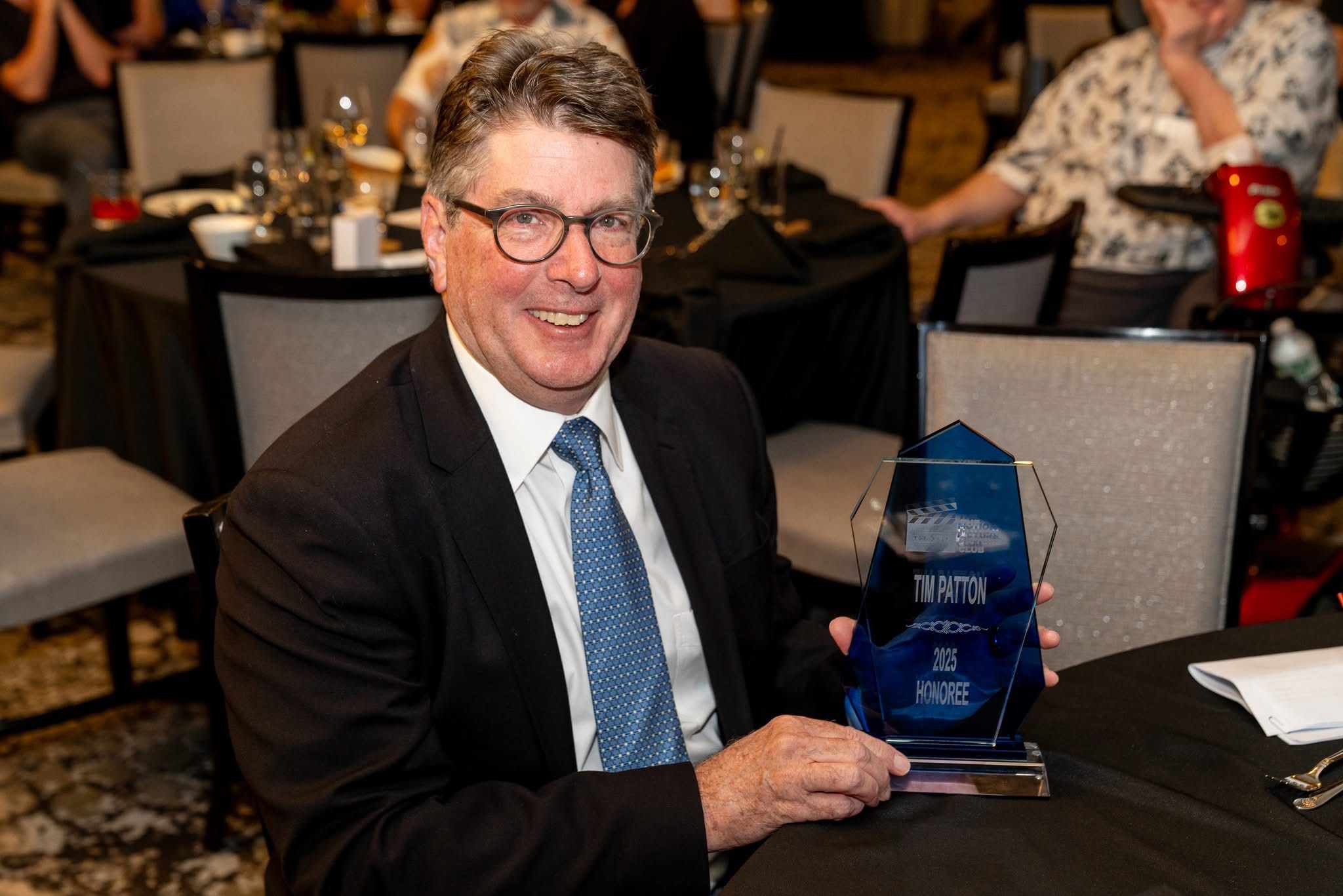
An established veteran of the cinema industry, Tim Patton has built a career in film booking and programming across major cities like Dallas, Boston, and Los Angeles for some of the most prominent companies in the entertainment business. Patton joined Cinema Service Company in 1991, a full-service film booking company assisting cinemas with programming, box office reporting, and distributor negotiations. The recipient of this year’s Distinguished Service Award at CinéShow, an event he’s had strong ties to over the years, Patton sat down with Boxoffice Pro to look back on his career in film buying.
How did you get your start in the industry?
I started at 16 as an usher in movie theaters, and it just kind of stuck. Back then, I worked at the Granada Theater in Dallas, a single-screen theater. It was known as a nostalgia house in 1974: the Marx Brothers, Casablanca, King Kong, and that type of fare. It fostered a love of movies in me, and I continued working in theaters through my sophomore year in college. I had the idea of becoming a filmmaker, but ended up back in distribution and exhibition after college. I worked in nontheatrical distribution in Boston for a time, and then I moved on to Columbia Pictures before finding myself at General Cinema Theatres. There are so many General Cinema alumni in this industry, you could probably fill up AT&T Stadium in Dallas with all of us if we were to have a reunion today.
After General Cinema, I worked for DeLaurentiis Entertainment and MGM before moving out to Los Angeles with Act III Theatres. In 1991, I had the opportunity to move back to Dallas to become a managing partner at Cinema Service Company, and that’s where I’ve been since. We started with 72 screens, purchasing the business from Bill Slaughter. He and his son, Rick, and I, along with Bill Herting, who was Regional Head Film Buyer at Cineplex-Odeon at the time, set out on this journey as partners.
You mentioned one of your first jobs in distribution was with Columbia back in the 1980s. Was that during the Coca-Cola days?
Yes, it was before Sony came in. I wasn’t there for very long. I started as a gross clerk and then became a booker. It was a great introduction to the business side of the movie industry, and I felt like I had found a comfort zone and people who made me appreciate the business side so much more. I was in the Dallas office with Jack Foley and Jerry Jorgensen. It was an interesting time, for sure.
And after a year or so, you end up making the move to exhibition with General Cinema.
I did. I worked for Bill Herting back then, and we had so many more titans of the industry at the company in that period. Jim Tharp, who went on to become the head of distribution for DreamWorks. Chuck Viane, who became the head of distribution for Disney. Barry Reardon, who served as head of distribution at Warner Bros., was there, and so was Tom Sherak, who held the same role at 20th Century Fox.
It was wonderful to be there in the mid-‘80s. Paul del Rossi was put in charge of updating what used to be these gunboat anchor theaters—they were basically seat farms—and turning them into new, modern cinemas. They had a great relationship with mall developers. It’s hard for a big company like that to move quickly on projects, but they had a lot of very intelligent people who helped launch the building spree behind that expansion.
When I started at General Cinema, we were booking for twins, triples, and quads, as well as a few multiplexes. The game plan for expansion was to start building larger facilities. Malls were expanding out into the suburbs at that time, and General Cinema was a big part of that movement. I think the mall-ing of America peaked in the ‘90s, possibly the early 2000s, around the time General Cinema’s growth began to wane.
After General Cinema, you went back to distribution with the De Laurentis Entertainment Group. You guys had a great run there, with some really interesting genre titles.
I was there around 1985–86, when it was a start-up company with Dino De Laurentis and his daughter. In the ‘70s, you would see a lot of subdistribution arms that could handle independent releases on a regional basis, taking a picture to cities like Dallas, Atlanta, and Chicago, and companies like the DeLaurentiis Group farmed out their movies to them for a national release. In the second half of the ‘80s, DeLaurentiis decided to go all-in with its own distribution arm. I was only there for a brief time, but we had a great run with some pretty interesting pictures.
You released movies from Michael Mann, David Lynch, Sam Raimi, Schwarzenegger … these are all household names today.
They were all really interesting movies and after I left DeLaurentiis to go to MGM, I found myself releasing some of the DeLaurentiis slate years later. MGM was a great time for me, and that’s another place where we had a fabulous run, with Alan Ladd Jr. at the helm. We had movies like A Fish Called Wanda, Moonstruck, and Rain Man. It was a lot of fun to experience a run like that.
From 1989 to 1991, I was in Los Angeles with Norman Lear’s company, Act III Theatres. They had made some instrumental acquisitions in Texas, which was emerging as a hotbed for the future of exhibition. There were some regional circuits out in Texas, like Presidio and Santikos, that were instrumental in moving the industry forward. I also need to credit AMC for their innovative theater design, which featured a hybrid between stadium and sloped-floor seating. That was a game-changer right there and led to the building of the AMC Grand in Dallas in 1995, the first all-stadium theatre in the country.
The next decade of your career, the 2000s, saw a significant shift in the exhibition industry, where the stadium-seating gold rush of the ‘90s took a left turn into a number of high-profile bankruptcies by the start of the new century. And by the end of the aughts, we’re in the middle of a digital transition. How was that period professionally for you?
This industry changes at a glacial pace. It took us 100 years to go from analog to digital. I remember George Lucas talking about going digital 10 years before anything started to happen. He was instrumental in pushing exhibition to adopt digital projection.
When that digital transition finally took place, it occurred as a cooperative effort between distribution and exhibition. Obviously, the change was hugely beneficial to the studios: They stood to save an enormous amount of money, not only in distribution but also in production costs. There was a significant financial incentive in terms of cost savings for studios to assist exhibition in this conversion.
There was a fear, especially in those early days, that the move to digital would put independent cinemas out of business.
A lot of our clients at Cinema Service operate in small towns and midsized markets. Places that are a little slower to adapt to these changes. It wasn’t an overnight transition by any means. By the time the technology and cost of conversion became affordable, you saw them all make their way over to digital. None of it would have been possible without the financial assistance of the studios and our distribution partners.
The Virtual Print Fee (VPF) model mitigated a lot of the potentially negative aspects of the digital transition. We lost very few exhibitors in small towns. We were even able to maintain dollar houses. Although it wasn’t a booming part of the business by any means, subrun theaters were able to stay in business.
You joined Cinema Service in 1991. How has the company grown since then?
Bill Slaughter, a long-time industry veteran, founded Cinema Service in 1985 as a film buying service specifically for small-town owners. Bill spent many years with United Artists Theatres and also worked with Carmike. He had vast knowledge and experience with smaller markets. He recognized the need for a full-service buying agency to support small towns in their programming and negotiations with studios.
That’s still a big part of the company today. When I came into Cinema Service 34 years ago, we were booking for about 72 screens. We grew the business to up to 1,200 screens up to the pandemic, and today we represent around a 1,000 in total. 2020 was a very challenging year, and I think smaller towns have had the most difficult time in rebounding from the pandemic. Most of our theaters in Texas were able to open earlier than some of our counterparts in California and New York, but there was nothing to play. Studios weren’t releasing movies, and whatever they were putting out was streaming day-and-date at home. We found ourselves booking a lot of repertory titles and worked closely with some distributors who normally wouldn’t have had access to our screens. We’re still feeling the effects of that period, five years on, in many of our small towns.
As a Texas-based company, you’ve been in the front row to witness some truly captivating innovations in the movie theater business. What makes Texas such an innovation hub for this industry?
Well, it’s pretty simple: It’s easy to build things in Texas. Cinergy went out to West Texas and got very creative, introducing some groundbreaking family entertainment concepts, as did Schulman MBG in mid-sized markets. On the dine-in front, we worked for many years with circuits like Alamo Drafthouse, Studio Movie Grill, and Movie Tavern, and currently with Flix Brewhouse and Look Cinemas. All are very influential pioneers in that sector. Santikos Entertainment has continued to expand and protect the San Antonio market established by John Santikos with new FEC builds, refurbishments, and conversions of older complexes. Premiere Cinemas upped its game in the state by introducing its Lux brand and bringing Imax to several locations. Even Louisville, Kentucky-based Xscape Cinemas built a couple of its mega-PLF concepts in the Houston area. There’s access to developing land out here that allows people to take a risk and build something new.
Cinéshow has grown significantly over the years. What do you think about the way the event has evolved into what it is today?
It’s remarkable what’s happened with Cinéshow over the years. We’re approaching 30 years of doing it, and I’ve seen it grow from 50 people to what we have today in Dallas: more than 400 registrants and 100 vendors at the tradeshow. It’s the second-largest cinema trade show in the country next to CinemaCon.
I’ve handled exhibitor relations—coordinating everything with our partners in distribution—at Cinéshow for many years now. We used to move sites when we first started doing it, hosting it in places like Shreveport, Louisiana, and San Antonio. We eventually settled in Dallas because it’s become a major hub for the industry. It’s also an easy place to get to, which is important as the official convention of the Theatre Owners of Mid-America (TOMA), which brings together operators from six states. It’s amazing to see it grow to what it is today, and I can’t be prouder of everyone associated with making it such a success.



Share this post