
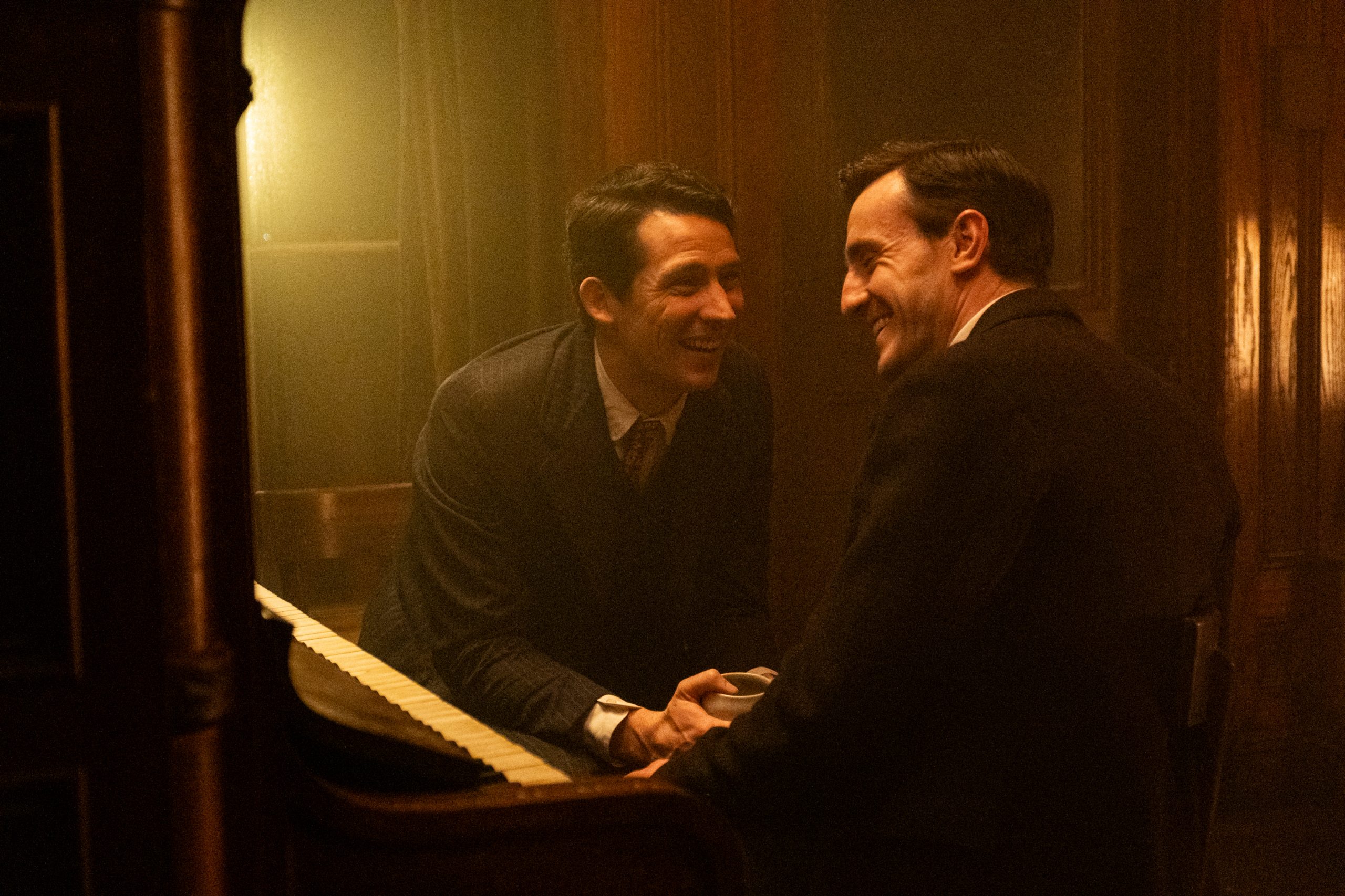
Directed by Oliver Hermanus and adapted from Ben Shattuck’s short story, The History of Sound traces the bond between gifted music students Lionel (Paul Mescal) and David (Josh O’Connor), who initially meet at the Boston Conservatory in 1917. Years later they journey together through the backwoods of Maine, where they’ve convened to collect and preserve traditional folk songs. The shared music project becomes a vessel for something far more resonant.
For Hermanus, whose body of work includes Moffie and the Oscar-nominated Living, Shattuck’s story offered a love affair unburdened by hesitation and a meditation on the ways in which sound connects us to memory and ultimately to one another. As the film heads from Cannes to theaters courtesy of Mubi on September 12th, Boxoffice Pro spoke with director Oliver Hermanus about the connective, transformative experience of sound and its significance in the theatrical experience.
I was listening to the crickets outside my window and thinking about how we don’t appreciate the sounds around us enough.
Yes, I’ve been saying this a lot recently because a big part of my way of relaxing is ASMR. I sort of love the weirdest of sounds. That’s such a powerful way of affecting our brains.
The phonograph really was a magical invention. How did you set about becoming an expert and then sharing that knowledge with Paul and Josh and the team?
It was a very hilarious day in my office, where Paul and Josh came in, and I had just learned how to use a wax cylinder recorder, and I was now going to be the teacher. They’re very delicate things, because the wax cylinders are actually quite fragile. It was a sort of hilarious trial and error of trying to get this original, more than a hundred-year-old piece of equipment to play on ‘action’ in a movie and for the actors to feel comfortable using it. It is the simplest invention, but it is also probably one of the greatest inventions—the idea that you can just cut into something, and when you broaden something over that, it produces sound.
The glass of drinking water is a moment that is scripted but feels very improvised. How do you approach finding the truth of a scene with your actors?
In this case, quite easily, because it’s Paul Mescal and Josh O’Connor. It was very early in our shoot. I think it was actually the first day of shooting that we did that. What I like about that moment, which was always in the short story as well, is that it’s surprising, but it’s also very intimate. In our lives, we have these memories of connective moments between ourselves and other people. People always think it’s going to be a look across a room, or eye contact, or something quite cinematic or that’s been overdone in movies. I like the idea that there’s this crazy idea in David’s head to spit water onto Lionel, and that becomes a kind of icebreaker. It’s crazy and simple and beautiful in a really original way, which I love.
What was your musical journey with Sam Amidon like, in terms of finding the right songscape for the film?
It was such a great experience and exploration. Sam really embodies this music. It’s part of his life, his childhood, and his parents—it’s his passion and his career. It’s always such a joy to me to work with somebody or to engage with somebody who is expressing and sharing what they love, because they do it with such generosity. Sam was just this wealth of love, and it gave me and the actors particularly an even greater kind of appreciation. We did a recording session where Sam was with Paul and Josh in a studio in New York. He would just teach them songs in minutes. In minutes, they’d be singing together and harmonizing. It’s such a powerful and beautiful thing to sing together.
One of the best parts of the theatrical experience is the experience of sound. How did you work with your sound designer, Ruy García, to create the soundscape and explore spatial sound?
For me as a filmmaker, the more I work, the more I find that there’s this secret to filmmaking, which is that sound is almost a more important textural, emotional element than the picture sometimes. Then you sort of think, ‘Oh, it’s about having a lot of sound or very loud sound.’ And then you go, ‘Oh no, it’s really about detail, texture, and control.’ For me, this form was an exercise in control for myself, to create an aural space that felt like it had dimension but that was nuanced. It’s a personal choice, I suppose every director has their own ideas about. For me, that was also part of the original score. I was trying to create a score that had this real fragility and lightness to it, which is the genius of our composer, Oliver Coates.
Because we are immersed in this very rich tapestry of sound, when there’s an absence of sound, that moment becomes very powerful. It felt like a reflection of the characters. What they’re not doing is as important as the choices and actions that they make.
Also, of all the things left unsaid in our lives. I think that’s a very powerful idea. It’s a very fragile idea as well, where the regret of what you didn’t say, or what you didn’t get across, or how things might have changed if you had stayed a little longer, or said something differently, or not said something that you said. I think we all understand those intersections in our lives, and we probably all spend a lot of time imagining the road untraveled.
The phonograph is an invention that takes something so ephemeral and puts it into a lasting form. That says something about the nature of cinema itself, these images and sounds that we’re capturing.
It’s like a time capsule, and it allows for time travel. We kind of take it for granted, I guess, that cinema allows us to step inside other people’s lives in different worlds, in different countries, and in different cultures. I think that that’s why I love making movies, and I also think that’s why my life has become a life of travel through movies. I keep making movies in different countries and around the world, and it has become personally defining in my own life, but also my films are now a reflection of where I’ve been and what I’ve encountered in some way.
The theater experience is one thing we have today that really harkens back to oral histories and stories through song: that kind of communal experience of sharing something together.
We express ourselves through music and sound. I suppose there was the great age of the mixtape, where that was your way of courting somebody or being courted. It’s a very common act of mine to discover new music and to want to share that new music with my friends and to denote how we feel. The simple idea of a wedding song, you know, we feel like that’s a narrative and a story you want to tell on the day of your wedding. You choose a particular song with particular words and meaning because it defines your love for the person that you want to hopefully spend the rest of your life with.
Much of this story is about encountering and then a parting of ways and letting go. How did it feel for you to release the film and begin sharing it with audiences?
It’s a funny thing, every time you get to that point where the film is done and the world is about to see it, and it will live in the world, hopefully for the rest of time. It is a strange goodbye, because, in a way, you want to let it go. I want the form to exist on its own and have its own voice. And at the same time, there’ll always be that desire to keep cutting away at it or doing something to it, the sort of directorial kind of obsession, but it’s the parting that is made sweeter by the fact that it’s an offering to people. You hope that it’ll help, in effect, or move or inspire strangers in the dark.
When you think about sound in the cinema, is there a particular experience or memory that comes up for you?
The very first time I ever watched a film at the Cannes Film Festival in the big theater was The Tree of Life. It was the premiere of that film, and I remember the room started shaking because the sound was so loud. The base of it was so vibrant. There’s a sequence in that where we’re seeing the creation, essentially. It’s visually striking, but it was so overwhelming in that room because you felt the power of the sound and the volume, and thus the scale of it was so intoxicating. I’ve never forgotten that onslaught of cinema. It was quite extraordinary.
How have experiences like that played into this film?
In a sort of amazing way, because The History of Sound played in that very cinema all these years later at its premiere. There I was sitting again, watching my own film, remembering the experience of The Tree of Life [about] 15 years ago. That was a very wonderful and serendipitous kind of experience. The History of Sound is not as grand or voluminous in that way. It’s the opposite, in a sense. It created a stillness inside of this incredible theater and gave an audience a different experience of a sound moment or a sound experience with movies.




Share this post