
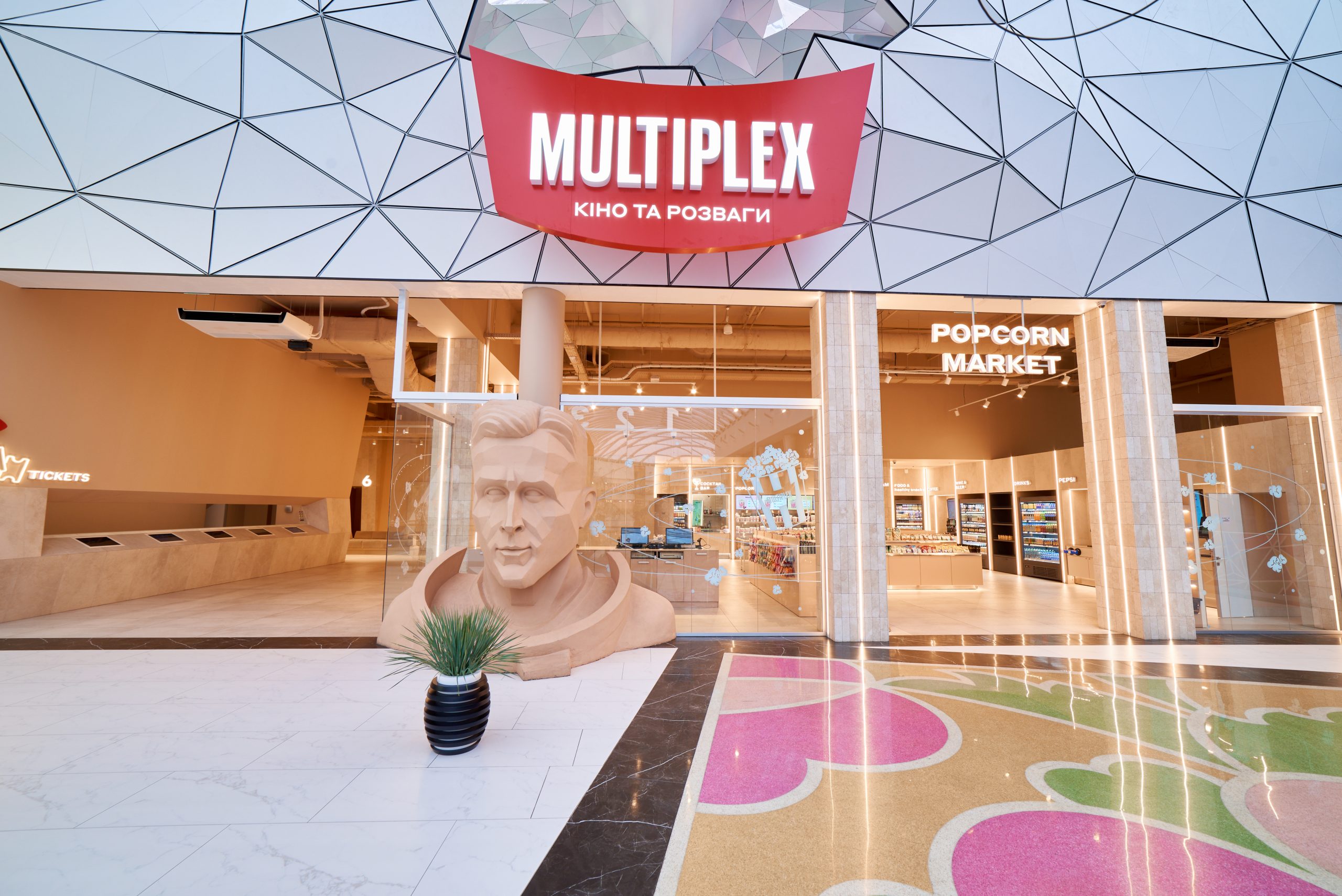
On June 23, CEO Roman Romanchuk will accept CineEurope’s 2026 International Exhibitor of the Year award on behalf of Multiplex, Ukraine’s largest exhibitor and a major driver of the country’s cinema resurgence.
It’s hard to imagine a more worthy recipient. Despite the incredibly challenging circumstances created by the country’s ongoing war with Russia, Multiplex’s footprint grew by roughly 11 percent in 2025. This was a result of new building projects, renovations, franchise reopenings, and acquisitions, including the acquisition of the renowned Kyiv-based art house cinema Zhovten, founded in 1931.
Focusing solely on the challenges posed by the war—the blackouts, the air raid alarms, the damage to cinemas—would constitute a failure to fully recognize and appreciate the immense role that Multiplex plays in Ukraine’s cultural identity. Among the uncertainty of everyday life caused by the war, the Ukrainian people have perhaps come to value the transportive power of cinema more than ever before. Amid this need for reliable escapism has come immense growth in the popularity of local titles. Here, too, Multiplex has played a key role. In 2023, the exhibitor founded Green Light Films, working with two veterans of Ukrainian distribution, CEO Veronika Yasinska and CCO Nadiia Zaionchkovska, to rebuild the country’s local film ecosystem.
“Under the leadership of CEO Roman Romanchuk, Multiplex has demonstrated exceptional resilience and commitment to the cinema sector, maintaining operations and continuing to invest in its circuit despite unprecedented challenges in Ukraine,” noted Andrew Sunshine, Film Expo Group president.
“Multiplex has shown exceptional leadership and resilience in the face of extraordinary challenges, maintaining and rebuilding its operations while continuing to serve audiences across the country,” said Laura Houlgatte, UNIC CEO. “Their commitment is truly inspiring, and we very much look forward to celebrating their achievements in Barcelona.”
In advance of this year’s CineEurope, Boxoffice Pro spoke with Romanchuk about the realities of theatrical exhibition in Ukraine.
How would you describe the average Ukrainian moviegoer’s taste in movies, concessions, and cinema experiences?
Honestly, the average moviegoer has become one of the least relevant categories for the Ukrainian market over the past few years. The war has fundamentally reshaped our audience, which is why [we now have] two or three distinct layers rather than a single average portrait.
Before 2022, the Ukrainian moviegoer looked fairly recognizable in a European context. Hollywood blockbusters carried most of the box office, local films held around 5 percent, and an appetite for premium formats—Imax, ScreenX, VIP—was already building. Back then, I’d cautiously say, yes, the average viewer exists, and they come for the event.
The picture today is completely different. Around 6 million Ukrainians have left the country, mostly women with children, who used to be the core of family- and female-skewed audiences. Many men are mobilized. For us, this isn’t an abstract statistic. It’s a concrete shift visible in our screenings: A clearly larger share of young adult and action horror [titles] are performing very well, and drama and art house cinema are gaining a life of their own. The audience has gotten younger and, more importantly, more intentional. People aren’t simply going out for the evening. They’re consciously choosing two hours of an alternative reality in very difficult circumstances. That changes everything, from programming decisions to how we design the emotional rhythm of every touchpoint inside the auditorium.
The most interesting shift is in Ukrainian cinema itself. Before the full-scale war began, local product accounted for around 5 percent of box office. By the end of 2025, that share had risen to roughly 16 percent, a more than threefold increase in just a few years. This isn’t a market blip: It’s a fundamental change in cultural habits. The Ukrainian audience has discovered its own cinema and is voting for it with their wallets.
As for the in-cinema experience, the Ukrainian moviegoer is demanding. Multiplex is known for its popcorn bar with dozens of unique flavors. That’s not a marketing flourish. It’s a response to a standard our audience is accustomed to. The same goes for formats: We were the first in the country to introduce Imax with Laser, ScreenX, and boutique auditoriums of 20-40 seats, and every [new addition] met ready demand, despite the war. I’d even say the war has intensified demand for quality experiences: When there’s so much unpredictability outside the cinema walls, people want everything inside the auditorium to work flawlessly, from the sound to the coffee.
So if I had to put it briefly: There is no average moviegoer in the classic marketing sense in Ukraine. There’s an audience that comes deliberately for the experience, and that’s what defines how we build every point of contact with it today.
What does your premium footprint look like, and what premium experiences do your audiences most favorably respond to?
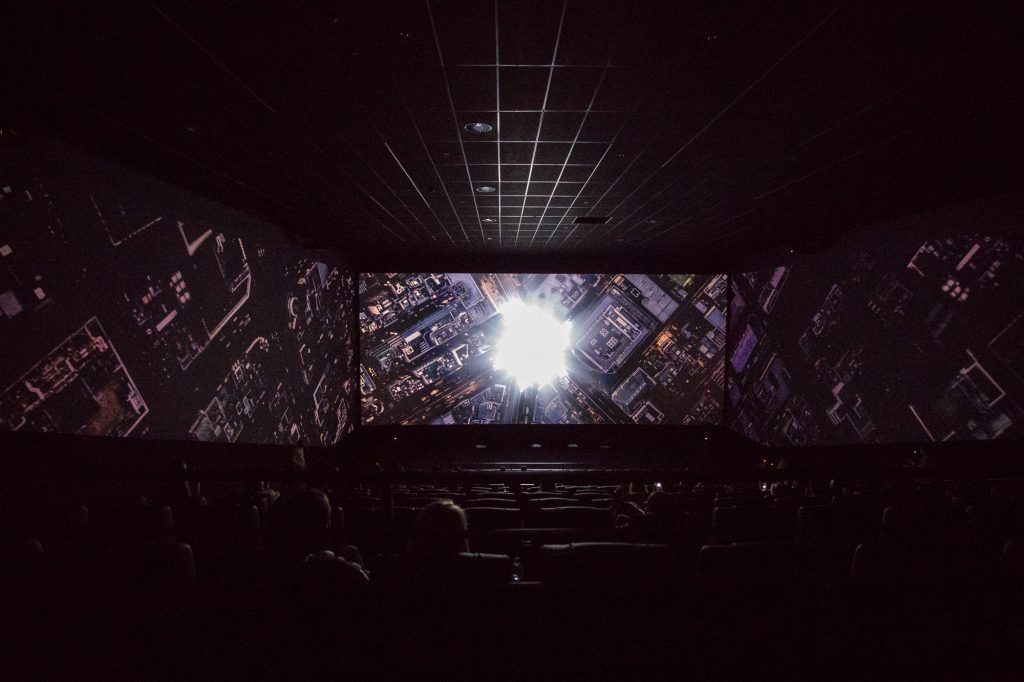
Premium for us isn’t a single category but several different promises to the audience that we hold in parallel. On the immersive event experience side, our Imax auditoriums lead the way—including the Imax Laser at our flagship in Lavina Mall, the first in Ukraine, which we launched back in 2019—alongside ScreenX with its 270-degree field of view and Dolby Atmos for event releases on the scale of Avatar or Dune.
On the comfort and lifestyle side, at Tsum, a department store in the heart of Kyiv, we have a VIP cinema with small auditoriums and full food and beverage service, plus the boutique format we’re systematically investing in: intimate auditoriums of 20–40 recliners, designed for adult viewers who come not to kill time but to have a specific kind of evening.
The audience response is probably the most interesting part of this story. Premium segments are growing faster than standard offerings, and this is against the backdrop of a striking pricing dynamic: Between 2022 and 2026, our average ticket rose from UAH 132 to UAH 196, but in hard currency terms, it has remained at around €4. That tells you something simple: People are willing to pay for the experience regardless of the macroeconomic backdrop, and the real value of a ticket has stayed at the same level as before the full-scale invasion. A paradox I often run into when explaining the Ukrainian market to Western colleagues is that instead of dampening premium demand, the war has intensified it. When there’s so much unpredictability outside the cinema walls, people come for a predictable experience. They want the sound to be perfect, the seat to be comfortable, the coffee to be done right. The premium auditoriums answer that need very literally.
There is one case that illustrates the dynamic well. In 2023, at the height of the war, we opened a boutique cinema in Uzhhorod. This was not an obvious decision, as launching a new project under wartime conditions requires real confidence in the market. The premium-segment dynamics since have validated that confidence.
How would you describe your leadership style?
Honestly, I don’t like describing leadership style in a single word; it’s almost always a forced simplification. But if I had to put it into words, I’d describe it through several traits that work together.
The first is structured thinking. I see my role across three axes: strategy, team, and structure. The work is a constant balancing of attention between them. On certain days I spend a lot of time on macro questions: where we’re heading, what the next growth horizons look like. On others, I go deep into a single function where the team needs reinforcement. It’s constantly zooming in and zooming out.
The second is a mentor-first approach, especially in the past few years. The war has put continuous pressure on the team: People relocate, get mobilized, or lose stable office environments. In that context, a leader can’t stay only above—you regularly need to step in alongside. I’m ready to [approach every element of the business] with as much depth as the moment requires.
It’s not micromanagement; when the team temporarily can’t close a gap on its own, it requires deliberate shifting of scale.
The third is rhythm discipline. We work in six-week planning cycles, giving us a clear horizon where the team has autonomy. Leadership has a [check-in] four times a quarter. In a war, where it’s impossible to plan years ahead, these cycles have become the backbone that keeps the organization in motion.
The fourth trait, probably the most Ukrainian one, is adaptability as the norm. We’ve long lived in a mode where we expect disruption. Blackouts, air raid alarms, direct impacts on our cinemas—these aren’t exceptional events. They’re the working context. Leadership in this environment requires the ability to reshape priorities within a day without losing the long-term trajectory.
A separate, very personal piece: I strictly protect my own rhythm. My day starts at 5 a.m. with a run, yoga, meditation. In the evening, I give myself mandatory time for reading as a way to step out of the operational context. Without that, a CEO in our reality simply burns out.
So if you need one phrase, I’d say “structurally flexible.” A leadership style that holds the frame but doesn’t treat reality as an adversary.
How do you balance long-term goals for Multiplex with more immediate, day-to-day requirements?
This question sounds different when applied to the Ukrainian market. The classic corporate dilemma of “long-term versus day to day” assumes that “day to day” is a baseline of stability that a CEO can lean on to think about the horizon. We don’t have that kind of stability in the usual sense. Disruption isn’t an exception; it’s the working context: blackouts, air raid alarms, direct impacts on cinemas, team relocations. Long-term and day to day aren’t two competing poles for us; they’re a single continuous process, and we pull from both ends at once.
On the day-to-day side, the key is operational readiness for disruption. Every one of our cinemas now has a generator, clear protocols for air raid alerts, and tested logic for the safety of staff and guests. Alarms interrupt screenings, but tickets remain valid for later showings; teams are able to restart a cinema within hours after a power cut. This isn’t heroism. It’s a system, and it absorbs a meaningful share of attention on its own.
On the long-term side, the principle is different: We don’t allow the wartime context to dictate an investment pause. In 2026, we plan to build eight new cinemas, including the boutique format, and to complete a full reconstruction of six existing sites. This is one of the most ambitious investment programs in Multiplex history.
The logic here has several layers. The first [relates to the realities of the market]: If we stop now, we will lose two or three years catching up later, and that’s a loss of position we can’t allow as the market leader. The second is broader but no less important to us. As a Ukrainian business, we see investment in the network as a form of direct support for the country, in very concrete ways. Expanding access to a quality cinema experience for residents of regions where that option either didn’t exist or didn’t meet a contemporary standard. Creating new jobs in local economies. Growing tax contributions. Every new site means dozens of new jobs and a real contribution to the budget of the city [in question]. By continuing to invest during the war, we are also sending a signal to the team, partners, and audience: We’re here for the long run.
The bridge between the two horizons is our operational rhythm. As I mentioned earlier, we work in six-week planning cycles. Within each cycle, the team has execution autonomy, but every six weeks we do an honest time-check against strategic priorities. That lets us simultaneously react to reality in the moment and not lose our trajectory. If we planned with classic annual budgets, reality would keep running ahead of us.
And one last, perhaps less obvious, detail: A leader can hold the long-term only when they consciously protect space for it within their own schedule. In a war, it’s easy to plunge fully into urgencies and wake up a year later with no movement on strategy, so a defined share of my time is formally protected for conversations about the horizon, with the team, with partners, and alone with myself. Without that discipline, the long-term simply gets eaten.
Through Green Light Films, Multiplex has taken an active role in the growth of the local cinema industry. How has the local filmmaking scene been affected by the ongoing war, and what are your major priorities at Green Light?
In the classic industry chain of international sales agent—local distributor—cinema network, Green Light Films and Multiplex operate in different, independent segments. What connects us is a shared conviction about the potential of the Ukrainian market, and it’s through that lens that I speak about its priorities.
The war has affected the Ukrainian film industry across several dimensions at once, and an honest answer cannot be reduced to a single line.
The first dimension is structural. Some industry professionals are mobilized; some work from abroad; some have stopped working altogether. Filming locations are limited by safety zones. Budgets are under pressure, both private and [those built through] state funding. Postproduction infrastructure has been through relocations. That’s the reality, and it would be dishonest to pretend otherwise.
The second dimension is a creative surge that was hard to predict. Ukrainian documentary cinema is currently going through a moment of global visibility it never had before. The Oscar for Mstyslav Chernov’s 20 Days in Mariupol was just the most visible point of a much wider process.
But there’s an equally important commercial side to the story. The best illustration is Nu, Mam! (Ну, мам), which Green Light released this year. As of late May 2026, it’s the highest-grossing Ukrainian film of the year and one of the top three highest-grossing releases in Ukraine overall, with more than 420,000 admissions. Why this matters: Just a few years ago, Ukrainian cinema was perceived mainly as a niche cultural product. Nu, Mam! shows something different: Ukrainian films are increasingly competing as full-fledged mainstream commercial titles, capable of generating large-scale audience demand even under wartime conditions.
The third dimension is a new culture of the theatrical release. Event-driven marketing has become an integral part of the Ukrainian cinema ecosystem. Large-scale premieres, influencer screenings, and talent-driven public events that bring together media personalities, creators, celebrities, and local audiences keep theatrical releases at the center of cultural attention. Under wartime conditions, this event culture has taken on a special meaning. A cinema today isn’t just a place to watch a film, but a social and cultural space where people come together. For a country living through what we’re living through, that carries a weight that’s hard to overstate.
As for Green Light’s priorities, I’d single out three. The first is delivering a high-quality, diverse repertoire to the Ukrainian audience. The Green Light team builds direct relationships with international rights-holders and production companies, with a focus on theatrical DNA—films that work on the big screen. That includes commercial blockbusters, prestige festival content, and European and Asian films with strong potential [in the Ukrainian market].
The second is supporting local production through distribution and co-production. Right now, Ukrainian cinema needs not only audience attention but also a professional partner that can take a film to market and help with financing. Green Light works with Ukrainian producers as a reliable theatrical and all-rights partner and is actively pursuing co-production opportunities.
The third is building a long-term, self-sufficient system. The Ukrainian media market has historically been self-sufficient and dynamic, both economically and culturally. Part of that work is developing a transparent, nationally rooted distribution system that operates by fair industry rules. The war hasn’t cancelled that trajectory: It has complicated it, while making it even more necessary. Green Light is a bet on a market that, we’re convinced, will be among the most interesting in Europe over the coming decade.
Personally, all of this is part of the broader logic I spoke about in the previous question. A cinema in our country is part of the cultural infrastructure. A strong theatrical market without strong local distribution is a house with one wall missing. What Green Light Films is building is exactly that wall, at a moment when it’s difficult but necessary.




Share this post