
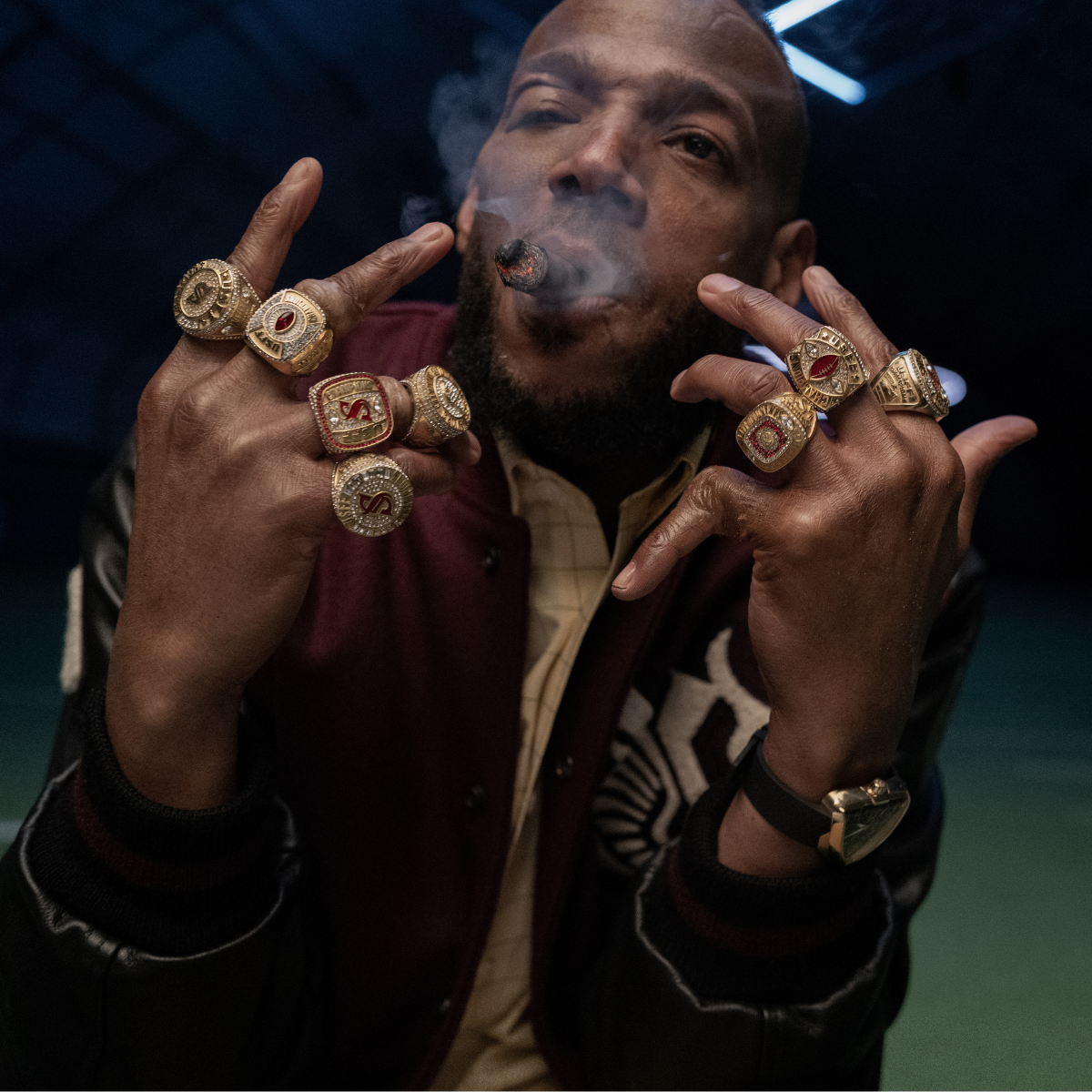
This September, football returns to the small and big screen with Universal Pictures’ HIM, a first-of-its-kind blend of sports drama and horror from Jordan Peele’s Monkeypaw Productions. Tyriq Withers co-stars as Cam, a budding football phenom taken under the wing of Isaiah (Marlon Wayans), a legendary quarterback whose training regimen includes some unexpectedly bloody surprises.
HIM is the second feature from Justin Tipping, whose 2016 release Kicks paired social realism and a neon-drenched, futuristic aesthetic to imbue an everyday story with a sense of gravity and myth. While in postproduction for his latest genre mash-up, Tipping spoke to Boxoffice Pro about the road from Kicks to HIM, in theaters (including Imax) September 19.
In the years since Kicks came out, you’ve done a lot of TV—directing episodes of The Chi and Dear White People, to pick only two from a lengthy list. Why the almost decade-long gap between movies?
It was so refreshing to go back to features. I got swept up in TV. It was the height of streaming, and all these shows were going [into production]. I did one, and then another, then the next thing I knew five years had passed.
It was necessary in a lot of ways. Student loans, debt, all those things. But it also helped me flex my craft. Just basically getting more reps in. You don’t have to be so precious because ultimately it isn’t your baby the way it is in film. [Working in TV] turned another muscle on, where I could look at any scene five minutes before I showed up and know exactly how to block it, how to shoot it, where to go, which is a gift and a curse because sometimes coverage is the death of style. But those tools were very necessary to get this movie made. With every production, curveballs get thrown at you.
[HIM] is my first studio film, so I still have a lot to prove. The script found me in a place where I was burnt out. The grind of television is intense, and I pushed myself too far. I needed to take some time off and do some soul searching and go back to what got me into this in the first place, which is film features. As soon as I did that, the script came across my desk, and the rest is history.
Kicks was a very personal film for you. It was inspired by an event from your own childhood, when you were mugged for your shoes. Was it harder to connect to HIM’s script on the same level? What were your initial thoughts on it?
I had an immediate connection. They wanted a writer/director to come in and make it their own, so I did. For a lot of people, post-Covid—and just in general, in the zeitgeist—there’s a lot of questioning about how much we give to our jobs. Are we doing what we love? It felt like a collective trauma, where everyone was reminded of their mortality and that life is too short.
At its deepest core, the script is asking: “What are you willing to sacrifice to be great at what you do?,” in relation to the psychology of professional athletes. Beyond that, it could apply to musicians, filmmakers, writers, anyone who’s invested in a craft. I, myself, was an athlete growing up. My first word was “ball.” I played every sport. I was voted “Most Athletic” of my senior class. I played soccer in college. I understood what that [dedication to sports] feels like. I can’t point to a comp in which something mashes up a sports drama and horror. A lot of me was already in the script, so I knew exactly what I would do with it. It just flowed.
Going back to Kicks: Dramas about the everyday lives of people in poor urban communities are often filmed in this very gritty, Bicycle Thief way, where all the colors are muted and everything’s very toned-down visually. Going against genre conventions really makes Kicks stand out. What was your design for the visual style of HIM?
I gravitate towards social realism as the grounding point of the stories I love, and then you imbue social realism with iconographies from other genres. Kicks is this exploration of toxic masculinity and commodity fetishism, but I wanted to give it a bigger weight, an Odyssey sort of feel. Choices like where to use slow motion or when to use a classical score, they’re very calculated to give the feeling that the scope is bigger, even if the moment between the characters might be very [mundane]. It’s chasing the emotional weight. It’s not style over substance; you’re finding the core of these themes and then trying to figure out a cinematic way to express them.
Cut to 10 years later: What happens if the athlete becomes the commodity? Their body is their one thing, their capital. One of [the elements of HIM] that wasn’t on the page is this combination of thermal and x-ray and ARRI footage, where you can see inside the bodies of athletes colliding. What does it actually feel like? How do you express it to someone who’s never been hit that hard or torn an Achilles tendon or broken a bone or had a concussion? No one had ever done that; our AC had to 3D print a focus rack puller for a thermal camera. We jerry-rigged the thermal camera onto an ARRI and had fun. We discovered this new language where we could flicker in and out of ARRI and thermal, and it became part of the language of the movie.
It feels almost like body horror, which football kind of is anyway–these guys are having concussions and getting traumatic brain injuries as part of their job.
The game itself is violent, and body horror is inherent in it. On a TV broadcast, you don’t have to look at it: They just cut away, or the injured player goes into a tent. I lean into the psychological horror of an athlete’s mind. A lot of what I was referencing was Jacob’s Ladder and The Shining. If you sacrifice so much of yourself to become something, at what point do you not recognize yourself? For me, that’s a very bone-chilling thing to consider because you wouldn’t be aware of it. You’d have become just another soldier. At a certain point, you have no reference.
I’m really looking forward to seeing what Marlon Wayans can do with the role of Isaiah. His performance in Requiem for a Dream was amazing, and he’s barely done any dramatic acting since. Was any of the cast in place when you came on board?
Nothing was in place. People thought I was crazy at first to go after Marlon because Requiem for a Dream was the last dramatic role he did. He’s a GOAT in his own right. I didn’t want to cast somebody younger that who had a certain physique and age them up. I wanted to cast someone who was older and, if anything, age them down because that’s more thematically in tune with what every athlete is going through. They’re constantly trying to figure out how to beat nature. I knew what he was capable of, and I was excited to give him his flowers, and the opportunity to express a range of emotions.
The younger character is supposed to be a fish -out -of -water who’s taken under the wing of this mentor, who’s a larger-than-life kind of person. Carmen Cuba, our casting director, pointed out Tyriq Withers. I remember seeing his episode of Atlanta. I went to his Instagram, and there’s this BTS clip of him giving his speech, thanking everyone in the cast and crew. It was very sincere. There was something there that you couldn’t teach. And then oh, by the way, he’s a freak athlete himself. He only played one year of football in high school, his senior year, and the next year he started playing for Florida State. That’s not normal! It was really important that the sports be authentic. I can’t stand movies that think they can get away with it. I couldn’t let it be that. [Tyriq] was a wide receiver, but he’s also a naturally gifted quarterback—everything in the movie, that’s him. There’s no cutting. That’s just how good he is.
What movie theater would you go to growing up?
Emery Bay Theater in Emeryville, [California]. Actually, that’s the theater where I got jumped. I got jumped outside, in that parking lot, over my Nikes.
You started your filmmaking career right there.
Theaters, for me, are a place to bond. My father loved film. He was the only person I knew who would see movies by himself, which I thought was crazy. Now here I am, doing the same thing. Every time I make a movie or TV show or anything, I’m never not considering an audience’s point of view and how they’re going to feel.




Share this post