
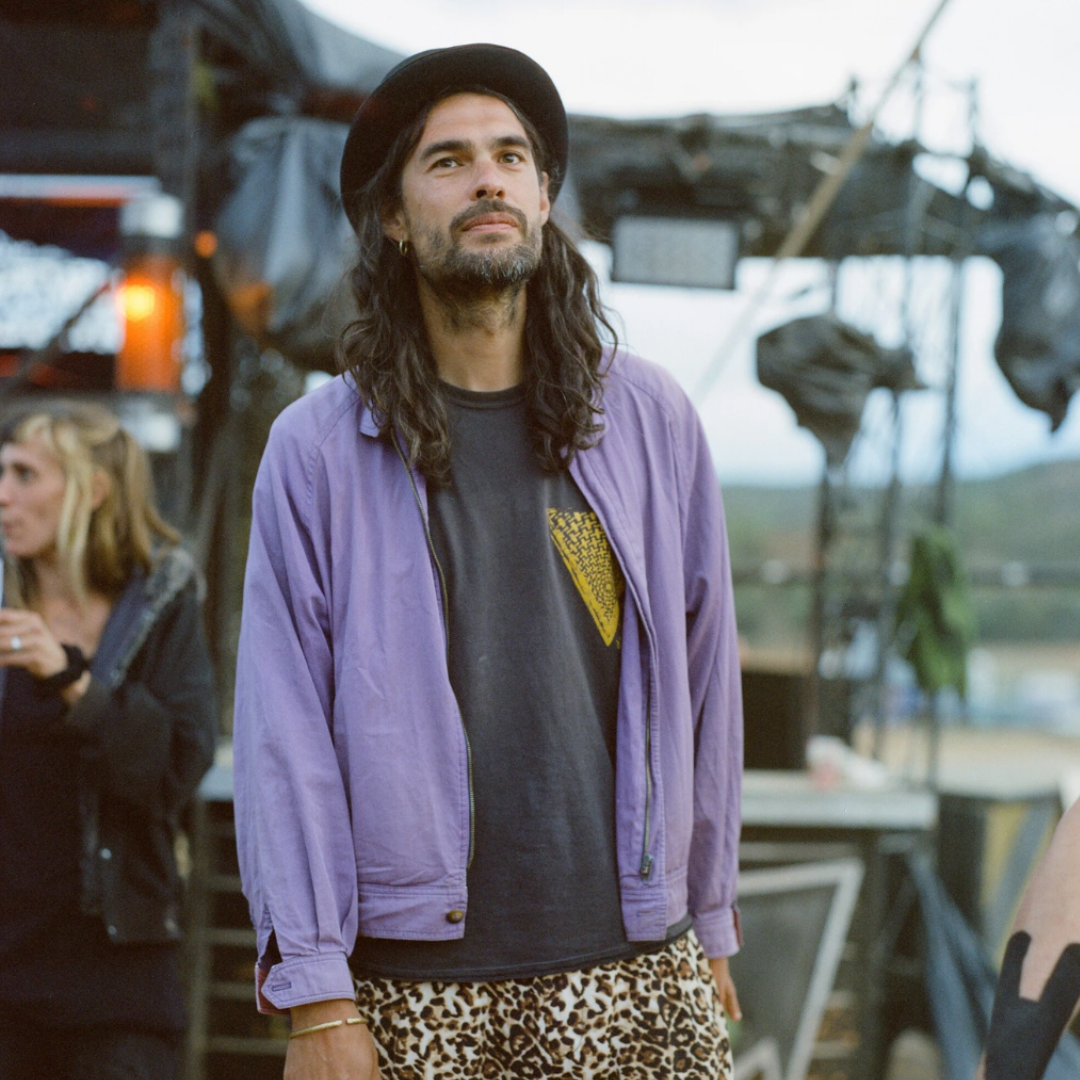
On this week’s episode of the Boxoffice Podcast, director Oliver Laxe talks balancing clarity and shadow with his new film Sirât, nominated for two awards (Best Foreign Film, Best Sound) at this year’s Oscars. Sirât is currently screening in domestic theaters courtesy of NEON.
Sirât is an experience to watch—it’s definitely the sort of movie you want to see with a crowd of people to experience their reactions. Can you speak a bit about your experience of seeing people respond to the film?
We are showing people that a theater is a place for catharsis, for transformation. When you watch Sirât, you die. And that’s what we wanted. The spectator has this experience of dying and rebirth. [Sirât’s reception] in France and Spain makes me really optimistic. In France, we have almost reached 800,000 spectators. With a film like Sirât, that is really radical. People who are not cinephiles, they were saying, “You have to watch this on the big screen.” I was talking to [Cannes Film Festival director] Thierry Frémaux when we were at the Golden Globes together. He told me, “You need to make films that people know you can only watch on the big screen, surrounded by people who understand that cinema is a place for transformation.”
From the very first scene, with ravers dancing in the desert, the film gives you a sense of the importance of connecting with other people.
We are living in a fragile moment for cinema. Most films, I can watch them on a plane. It doesn’t change anything. But this one is different. It’s a pity when you are driving a Ferrari, running 30 miles per hour when you can go [so much faster]. Theater is really a spaceship. For me, [appreciating the big screen experience] is a big thing. I work with a Spanish platform that allows me to go to festivals and to be [in a theater] for four months. For me, that is a red line. I don’t think I will work with a platform that doesn’t respect theaters. I will have to be careful. It’s in the hands of the filmmakers. In Spanish, we say “Bread for today, hungry for tomorrow.” Cinema is a good place for pedagogy. We have to keep this collective ceremony that is going to a theater.
Are there any childhood experiences of going to the cinema that stand out as being particularly impactful on your road to becoming a filmmaker yourself?
I was six or seven years old when I watched The Bear, from Jean-Jacques Annaud. It’s a silent movie about a small bear that gets lost, and I remember he eats mushrooms, so you have a kind of trip in the middle. Imagine, you are six years old! I’m 40, and when I remember these images, I still feel the film in my skin. What happens in a theater between an image and the human body, the human metabolism, is something really complex. The experience of watching a film in a big theater [isn’t just about how] the screen is bigger and the sound is bigger. You’re creating a social ceremony. There is a subtle and secret exchange of energy in a theater. We have to underline that going to the cinema is a transcendental thing.
Sirât is a pretty nihilistic film at times, but it’s also funny in some places—hopeful in the midst of tragedy.
My intention was to inspire light. Sometimes you have to go through the shadows. But I wanted to make a popular film. I trust in cinemas and in the sensitivity of the spectators. My cinema is really ambiguous. To be clear is easy. When you are too clear, you don’t evoke. It’s always a balance between clearness and shadow. It was our intention to have a dialogue with young audiences. I don’t know about the U.S., but in Europe, only people 40, 50, 60 years old are going to the cinema. I broke my head thinking, “How can I welcome young audiences to watch my film?” And I think that the genre is the hook. Sirât is a bitter medicine. Sometimes it’s painful. Sometimes medicine doesn’t taste good, but you have honey on the edge of the glass. The honey is the journey. Sirât has an intensity. It’s an arthouse film, but it’s sexy. It moves. You get hooked, in a way–there’s a kind of magnetism with the images and sound.




Share this post