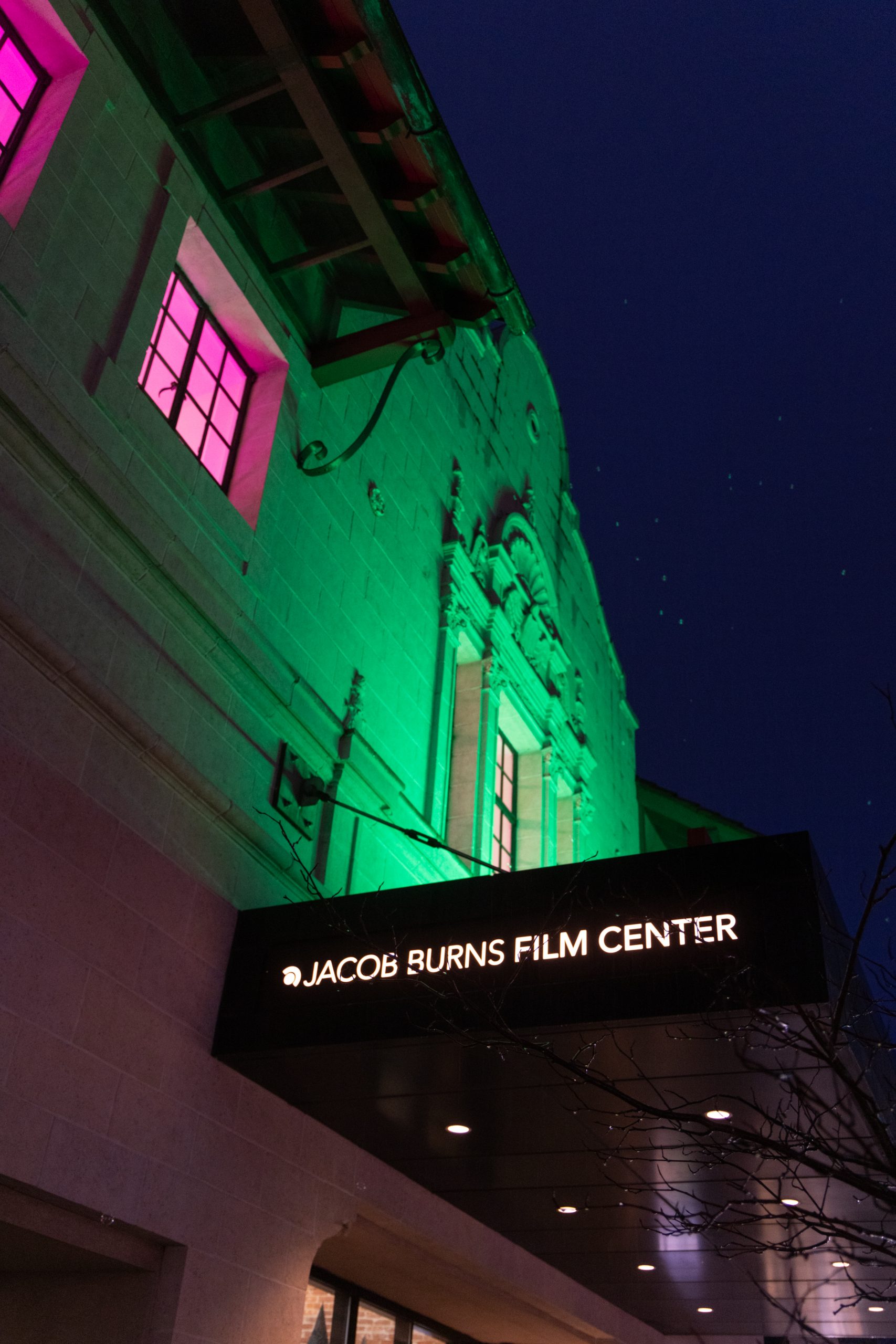
Located in picturesque Pleasantville, New York—a 30-mile train ride north of Manhattan—the Jacob Burns Film Center has established itself as a moviegoing destination for cinephiles in the New York metro area. The site originally hosted the Rome Theater, a local fixture dating back to 1925, before the historic cinema closed its doors in 1987. In 1998 Stephen Apkon, a local Pleasantville resident, led a group under a nonprofit organization to acquire the Rome Theater and an adjacent lot to renovate and reopen their local cinema.
It would take an additional three years of work and fundraising before the Jacob Burns Film Center opened its doors to the public as a three-screen venue. Further expansion to “the Burns,” as it’s called, saw the opening of its Media Arts Lab in 2009 and two additional auditoriums in 2015. Today, the cinema is one of the premier arhouse cinemas in the United States, housed in a 47,500 square foot, three-building campus that has welcomed filmmakers from around the world and students from the surrounding area.
Boxoffice Pro spoke with Mary Jo Ziesel, Jacob Burns Film Center executive director; Eric Hynes, director of film curation and programming; and Brandon Shenkman, director of education, to discuss the anniversary, the cinema’s history, and its long-lasting commitment to film literacy and education.
Could you give us some background on the cinema and its role in the local community?
Mary Jo Ziesel: We’ve always been a community-forward organization. We are celebrating 25 years in 2026, and the Burns has always been a place to platform issues that our community is thinking about, whether it’s Lyme disease or Alzheimer’s, access to health care, or a documentary on bees. It’s very important for us to respond to issues our community cares about and to bring the finest possible film exhibition of movies from around the world. We have brought in thousands of filmmakers, showcased the best of documentary and narrative cinema, and invited artists from around the world to share their gifts with our local community.
How would you describe the Pleasantville area in Westchester County?
Brandon Shenkman: Pleasantville is a beautiful little town, even if it’s not so little anymore; it was smaller when we opened in 2001. I’m local to the area and was lucky to grow up with the Burns and see it evolve. We have people with many different interests and passions who come together in our theater, where, hopefully, they realize they have more in common than they thought. We work with 80 different schools throughout the year from all across Westchester County, down to New Jersey, and over in Connecticut. It’s really nice to get them in the same room so they can experience what it’s like to be outside their school’s bubble. I think when they can experience movies alongside people from a range of backgrounds, it makes many of the stories we show more impactful.
In terms of programming, what sort of identity does the Burns have?
Eric Hynes: While this is our 25th anniversary, I’m just finishing my first year [as director of film curation and programming], so I’m coming to the Burns at a particular moment when its reputation precedes it. I’m New York City–based, and I’ve known of the Burns since the very beginning because of how significant the programming was from day one. There is an appetite to bring the world of cinema to Westchester, and our programming has always run the gamut. As a programmer, you can’t ask for more than having this kind of adventurous and diverse programming. It’s become something our audience expects, which is ideal.
The Burns also stands apart as a suburban multiplex, offering programming that contrasts sharply with the sort of films shown at a local multiplex.
Eric Hynes: We are a home for those who really enjoy the theatrical experience and want to experience films as a community. We also have filmmakers visit and share their work with our audience; these are things the Burns can do that the multiplex can’t. There’s a place for the multiplex, and there’s a place for the films in those theaters, but I think there’s a difference in the connection and engagement folks have with the films and filmmakers we program. I think that’s what keeps them coming back to our theater.
The Burns is well known for its guest speaker program, having hosted countless filmmakers over the years. What advice would you give to other independent cinemas looking to start their own Q&A program?
Eric Hynes: We’re not alone in being an art house with a guest filmmaker program; it’s always been part of our DNA at the Burns. The approach of our founder, Stephen Apkon, was to always think of this project as a communal opportunity to become literate citizens and provide filmmakers with an ideal audience for their work. It’s a matter of being able to support bringing guests in, but also ensuring those guests are willing to come. You need to create a reputation for high-quality conversation, and quality programming brings people out. Studios and distributors will make it possible for folks to come to you if there’s demand from their artists to be a part of your program. The Burns reputation precedes it; I knew about the theater before I even visited. Yes, there are budgetary elements involved in bringing speakers, but more importantly, it’s about creating a space the artists themselves want to come to. There is also an artist’s residency, and there’s the media lab and education facility that Brandon heads. Most theaters lack those elements, and they help create an environment artists want to be part of.
The educational aspect of the Burns also stands out. How has this helped establish the cinema’s role in the community?
Brandon Shenkman: We opened in 2001 in the remains of the Rome Theater, which had been a big fixture in Westchester since the early 1900s. Our Media Arts Lab opened in 2009 as a specialized education facility. We try to get as many students—young, old, any age—as possible through our doors every year. We serve about 6,500 people yearly, many of them through school programs for grades 3 through 12.
Since its founding, the Burns has always had a mission to educate. We try to give students a filmmaker’s tools to analyze and think critically about what they’re seeing—whether it’s film, television, or social media—and the creative ability to lend their voices to the conversation and be creators themselves.
We think that’s very important to being a citizen in today’s society, and it takes various forms in school programs that teach visual literacy. We have screening programs where students interact directly with directors, producers, and actors and where there are student-led Q&As. We have created after-school programs where students learn to make films, and we screen their films at our theater. At the highest level, we offer free, stipend-supported fellowships with NYU, Imagine Entertainment, Stony Brook University, and several high schools to support budding filmmakers. For those who really want to live a life in the arts, we provide the boost and skills necessary to develop a portfolio that can help them gain admission to a higher education institution or enter the industry.
What is behind the success of your membership program?
Mary Jo Ziesel: I think that because we are so connected to our community, they really showed up for us during the pandemic. Our ticket sales and our membership base are up to, if not beyond, pre-Covid levels. About 10,000 households are members of the Burns, and we’ve always enjoyed a strong membership base.
Thanks to the variety of programs we offer, we’re constantly trying to build new audiences. One of the things I’m passionate about is building the next generation of movie lovers and movie makers. We have something called All Ages, which is family programming. There is nothing more enchanting than hearing a room full of four-year-olds at a Frozen sing-along, and we’re making efforts to make these experiences unforgettable. We’re also trying to make these experiences intergenerational. We have people going to see Bambi with their grandchildren, but younger audiences are also coming back to see these films—people in their 20s and 30s. We have audience members seeking the 35 mm experience, and we are seeing younger people come out because they crave the opportunity to come together. Nothing will spark conversation, open minds, and build community more than an experience at the Burns.
You celebrated your 25th anniversary with a special gala this year. Can you tell us more about the event?
Mary Jo Ziesel: It was a meaningful gala celebrating this organization’s 25th anniversary and all the people who helped shape the Burns into what it is today. We honored actor Carrie Coon and our visionary founder Stephen Apkon, who dreamed and built up not only the film center but the Media Arts Lab and was very clear about the importance of visual literacy and critical thinking skills that kids would need.
We also honored our long-time, ever-magical development director, Judy Exton, who’s been with the Burns for the last 25 years. It is so rare for a nonprofit to have someone who has committed a large chunk of her life to ensuring that it is sustainable, so each of those honorees reflects a different part of our organization’s history. It was a great occasion to not only honor those folks but also our community, which has been by our side since the very beginning.



Share this post